After Velázquez: The Rokeby Venus
A back that was looked at for two and a half centuries, slashed once, mended, and now carries a picture of its own.
Diego Velázquez · 1647–51 · National Gallery, London

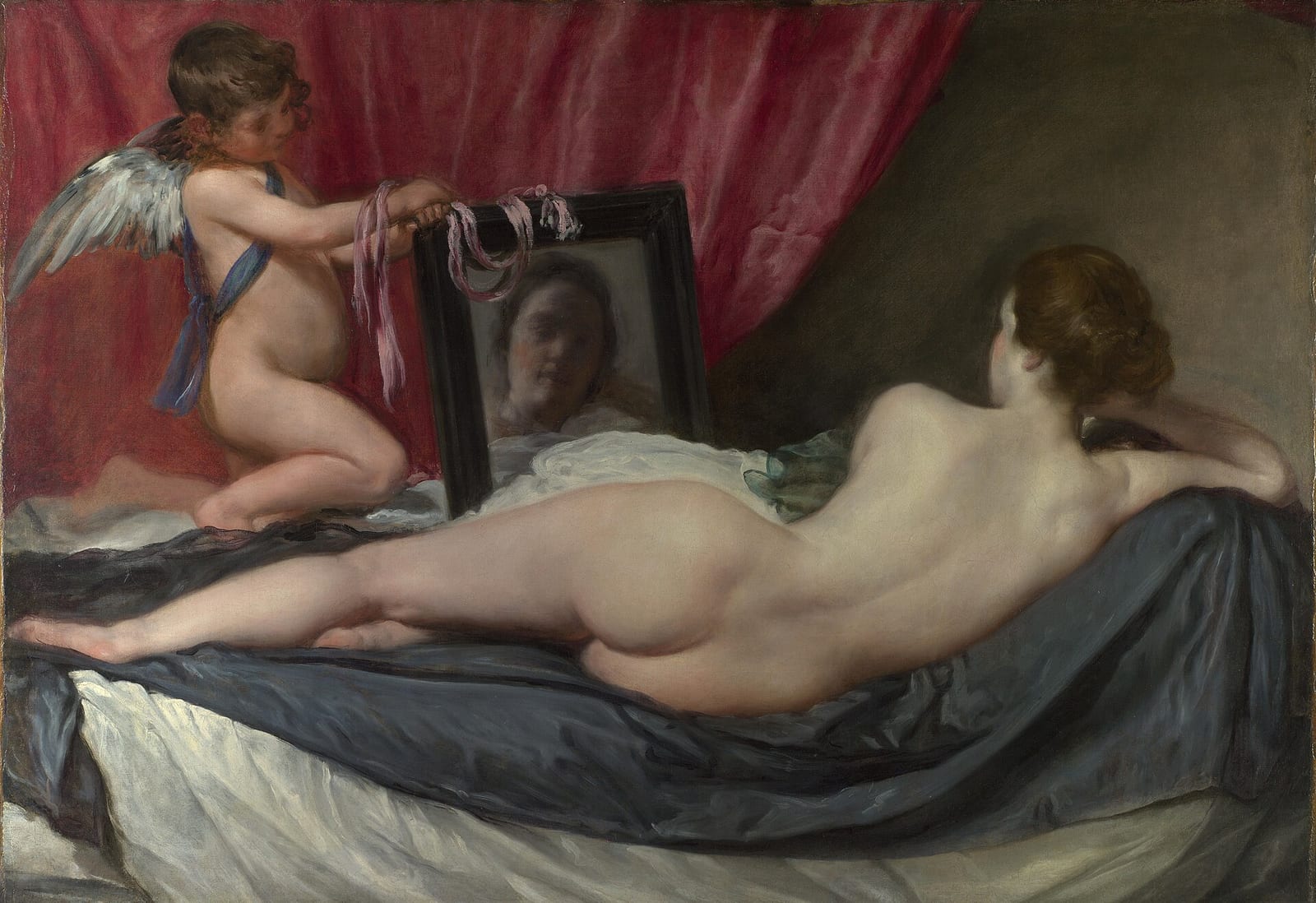
The original
Diego Velázquez, The Toilet of Venus (The Rokeby Venus), 1647–51, National Gallery, London · Wikipedia

Monica's drawing
Backpiece: magnolia in a lace frame · Monica, Dark Autumn Studio

On skin
AI visualisation of a real design. Not a photograph of a tattoo.
The painting
Diego Velázquez painted the Toilet of Venus between 1647 and 1651; it hangs in the National Gallery in London and is the only female nude by him that survives. Cupid holds a mirror, and the face in it is blurred and at an angle that cannot be right, which is the point: she is looking at you looking at her. In 1914 the suffragette Mary Richardson walked in with a meat cleaver and cut the canvas open, in protest at the arrest of Emmeline Pankhurst. Restorers closed the cuts. You cannot see them now. They are still there.
The design
Monica's backpiece: a magnolia opening inside a pointed, lace-edged frame on a solid black ground, with fine-line leaves spreading to the shoulder blades and the hips. It runs from the neck to the small of the back and is built for exactly this view.
Why this pairing
This is the kintsugi painting of the series. A surface that was broken and repaired, and more famous for it, not less. Velázquez painted a back to be looked at. We let the back answer.